
What Is Omnichannel Patient Communication? WhatsApp, Instagram and Telegram on One Platform
When a patient wants to reach a clinic, the clinic does not decide which channel they use. One patient writes on WhatsApp because they already keep that app open. Another writes on Instagram DM because that is where they discovered the clinic. Another prefers Telegram because it feels more secure. The same clinic gets three streams of requests on three different platforms at once, with no awareness of each other.
18 May 20269 min read
In this article
- What Is Omnichannel Patient Communication?
- The Three Channels Play Different Roles in a Clinic
- Single Panel: The Visibility Problem Goes Away
- Patient Context Travels Across Channels
- The AI Assistant Works on Three Channels at the Same Time
- Semi-Automatic Mode: Staff Take Over When the AI Isn’t Enough
- Managing Spam and Unwanted Messages
- Which Clinics Benefit Most From an Omnichannel Structure?
- Frequently asked questions
- Three Channels, One Platform, Zero Blind Spots
Following these three channels in separate apps takes time and has unavoidable consequences: missed messages, unanswered appointment requests, patient information scattered across different platforms. Staff spend a large part of the day switching between apps, and even so full control is not achieved on any channel.
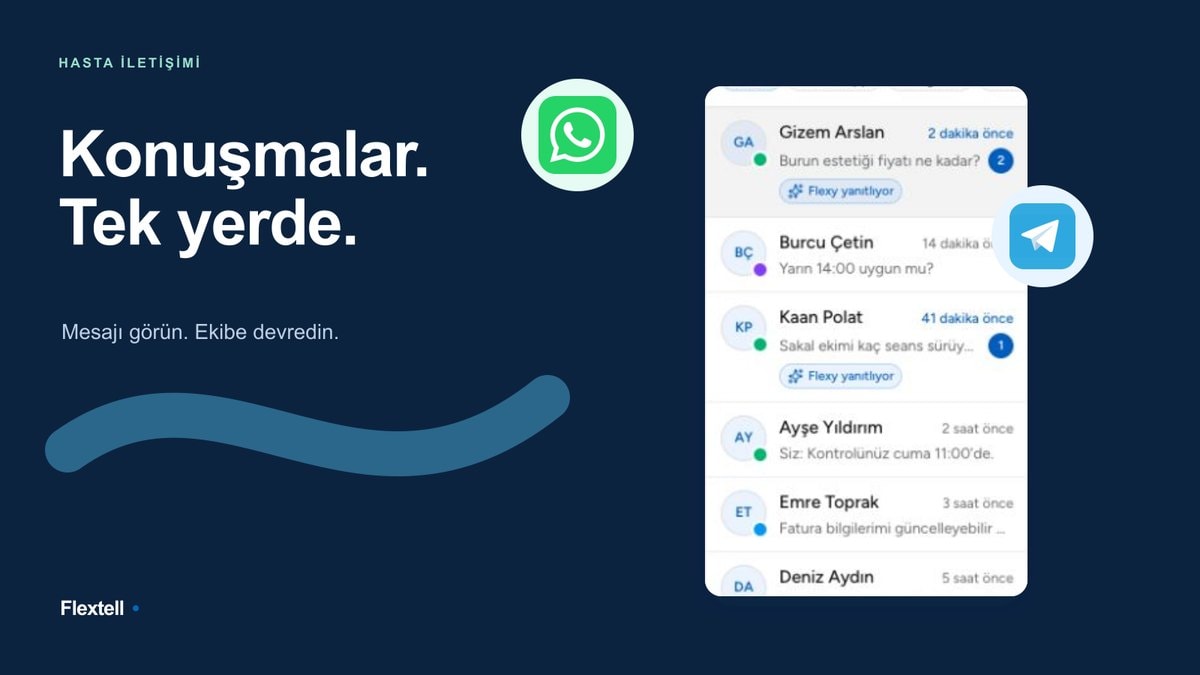
Flextell’s omnichannel structure changes this picture at its root. All messages arriving through WhatsApp, Instagram DM and Telegram are collected in a single Flextell panel. The AI assistant works on these three channels at the same time; replies, appointments and patient information are managed in one ecosystem. Staff do not switch apps or chase messages; the system does this automatically in the background.
In this guide we walk step by step through what omnichannel patient communication means, how it works in Flextell and what concrete value it adds to a clinic.
What Is Omnichannel Patient Communication?
Omnichannel patient communication is the approach of managing patient messages that come from multiple communication channels (such as WhatsApp, Instagram DM and Telegram) through a single central platform.
An important distinction needs to be made clear here: having multiple channels does not mean being omnichannel. Many clinics are active on both WhatsApp and Instagram, but they manage these channels in separate apps, disconnected from each other. That approach is multichannel but not integrated.
In an omnichannel structure the channels are connected. Whichever platform the patient writes from, the message lands in the same inbox. The AI assistant monitors and answers all channels at the same time. When a patient books an appointment on WhatsApp and asks their next question on Instagram DM, the system carries that context; the patient does not have to be introduced from scratch every time.
Want to explore every dimension of the clinic AI assistant? You can find our guide to the clinic AI assistant here.
The Three Channels Play Different Roles in a Clinic
For the patient, WhatsApp, Instagram DM and Telegram are not alternatives to each other. Each serves a different patient behavior and a different clinic communication need. That is why managing all three together is a better approach than choosing a single channel.
WhatsApp: The De Facto Standard of Patient Communication
In Turkey, WhatsApp has largely replaced the phone call in patient communication. Appointment requests, time inquiries, cancellation notices, replies to reminders: a large share of these interactions flow through WhatsApp. Regardless of the patient’s age group and the type of clinic, this channel has become the primary communication preference.
What this means for a clinic is this: not managing the WhatsApp channel means not managing a significant share of patient requests. In Flextell, every message that arrives on WhatsApp lands in the panel automatically; the AI assistant processes appointment requests, answers questions and sends reminders on time.
Want to look more closely at clinic appointment management over WhatsApp? You can find our detailed guide here.
Instagram DM: The Channel of Aesthetic and Beauty Clinics
In aesthetic clinics, the patient journey mostly starts on Instagram. A photo, a reel or a comment: before the decision is made, the clinic is already being followed. When this early stage is complete and the patient decides to act, Instagram DM is their preferred first point of contact.
This dynamic makes Instagram DM a critical channel for aesthetic and beauty clinics. The patient writes at the moment their motivation is highest, from the app they happen to be in. If this request goes unanswered or is left until morning, the motivation cools or another clinic replies first.
In Flextell, once the Instagram DM integration is set up, messages from this channel land directly in the panel. The AI assistant receives appointment requests regardless of the hour; staff do not need to keep the Instagram app open separately.
Want to look more closely at appointment management over Instagram DM? You can find our detailed guide here.
Telegram: Reaching a Different Patient Segment
Although Telegram is less widely used than WhatsApp and Instagram, it can become the primary choice for certain patient segments. Telegram stands out clearly for privacy-focused users, people who do not want to link WhatsApp to their personal phone number, and clinics with a tech-savvy patient base.
Excluding this segment means giving up on reaching that audience. In Flextell, Telegram is part of the same integration structure; messages from this channel land in the panel, the AI assistant replies and appointments are saved in the system. There is no need to set up a separate management infrastructure for Telegram; it works in the same flow as WhatsApp and Instagram.
Single Panel: The Visibility Problem Goes Away
The most direct value of an omnichannel structure is visibility. The messages that slip by when tracking three separate apps, the requests left unread and the piled-up notifications disappear completely in a single-panel structure.
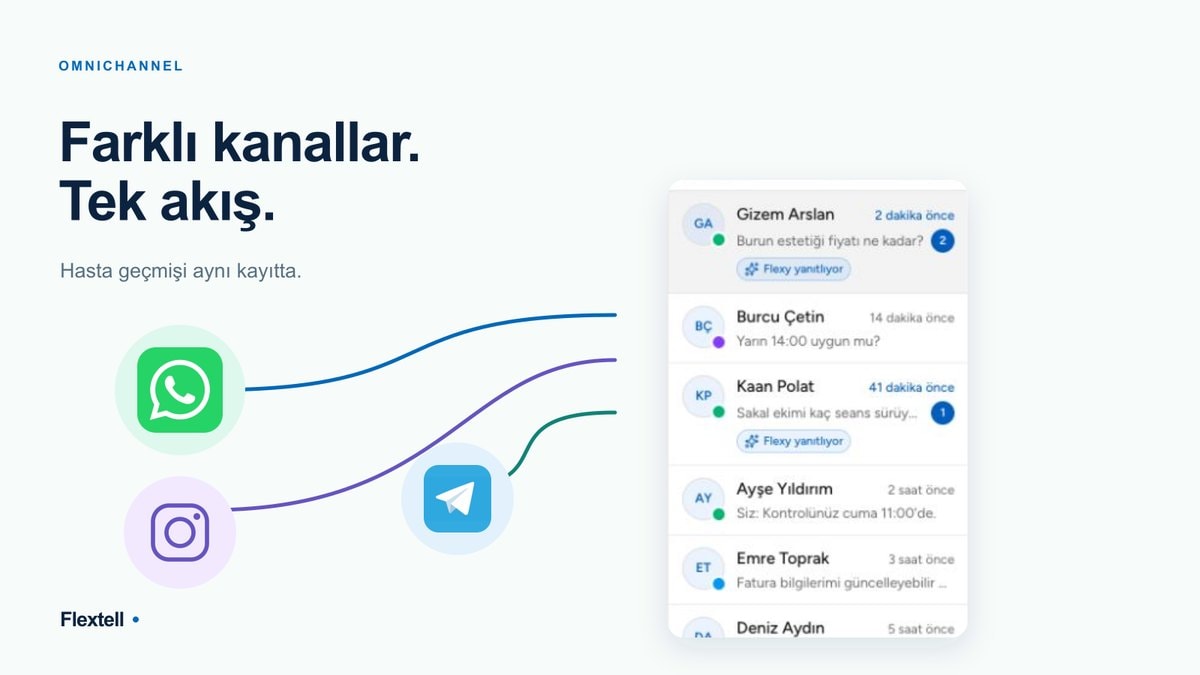
In Flextell, all messages arriving through WhatsApp, Instagram DM and Telegram are listed in a single inbox view. Which channel each message came from, which patient it belongs to and what it asks for are visible on the same screen. Conversations the AI assistant has answered, conversations handed over to staff and pending requests are all managed on one screen, with no separation by channel.
The practical meaning of this structure for the clinic is this: when staff arrive in the morning, all communication is ready in front of them, regardless of which channel it came from. There are no messages piled up on WhatsApp because the assistant worked there too. There are no unanswered appointment requests on Instagram because the single panel covers every channel.
Curious how a 24/7 automatic patient reply system works? You can find our detailed guide here.
Patient Context Travels Across Channels
The second critical problem multichannel communication has to solve is the loss of patient context. If a patient booked an appointment on WhatsApp and then sent a time-change request on Instagram DM, a system that tracks the two channels separately will not make that connection. When staff see the second message, they have to look up the first appointment separately.
In Flextell, each patient is represented by a single patient card, regardless of the channel they use. A patient record created in the first conversation on WhatsApp is recognized in a later Instagram DM or Telegram conversation too. The AI assistant recognizes this record in the new conversation; appointment history, treatment notes and contact details can be reached from the same screen.
This feature both saves time and improves the patient experience. The patient does not have to repeat their name, phone number and request every time; the system carries the earlier context.
Want to discover all the modules of the patient card? You can find our detailed guide to patient tracking software here.
The AI Assistant Works on Three Channels at the Same Time
The most critical component of an omnichannel structure is the AI assistant working in parallel on three channels. Unlike staff, who can attend to only one patient at a time, the AI assistant processes messages arriving from WhatsApp, Instagram DM and Telegram at the same moment, independently of one another.
At a busy lunch hour, an appointment request can arrive on WhatsApp, a price question on Instagram DM and a cancellation notice on Telegram, all at once. These three requests, each with its own conversation context and each from a different patient, are managed by the AI assistant simultaneously and independently of each other.
This simultaneous capacity becomes more decisive as the clinic grows and channel traffic increases. An increase in patient traffic can be absorbed by the assistant’s capacity instead of hiring extra staff.
Semi-Automatic Mode: Staff Take Over When the AI Isn’t Enough
The AI assistant provides a strong first-reply layer on all channels, but not every conversation can be completed automatically. An emotionally charged complaint, an unusual treatment request or a question that goes beyond the data defined in the system may require staff to get involved directly.
In Flextell, semi-automatic mode handles this transition. In conversations where the assistant is not enough or that call for a human touch, the system automatically creates a support request and sends a notification to the relevant staff. Staff take over the conversation and carry the process forward.
This transition works regardless of which channel it comes from. A conversation that started on WhatsApp can be handed over to staff midway; a complex request from Telegram is handled by the same mechanism. The efficiency of AI and the need for a human touch are kept in balance, whatever the channel.
Managing Spam and Unwanted Messages
In high-traffic clinics, all three channels can fill up from time to time with unwanted messages: ad content, repetitive queries or malicious attempts. These messages pull staff attention away from real patient requests and make communication harder to follow.
Flextell has a blacklist (blocking) structure to make cross-channel management easier. When unwanted messages are detected, the user in question can be blocked and disabled for all channels. This way clinic staff focus on real patient requests; unwanted traffic is filtered out by the system.
Which Clinics Benefit Most From an Omnichannel Structure?
Flextell’s omnichannel patient communication structure creates value for clinics of every size, but in some profiles that value shows up more clearly.
Clinics with a single doctor and an assistant: In setups with few staff, tracking each channel separately is a serious workload. The AI assistant working on three channels at the same time takes on this load without extra staff.
Aesthetic and beauty clinics: For these clinics, which get a stream of requests from Instagram, WhatsApp and sometimes Telegram all at once, a single-panel structure is indispensable. As the number of channels grows, keeping scattered messages together becomes more and more critical.
Laser hair removal and session-based treatment centers: A WhatsApp reminder for repeat session appointments, a new patient question coming through Instagram DM and a cancellation notice sent over Telegram all have to be managed at the same time. An omnichannel structure reduces this traffic to a single flow.
Multi-doctor polyclinics: In setups where several doctors with different specialties work, routing every request to the right doctor and preventing calendar conflicts regardless of channel makes manual tracking almost impossible. An omnichannel structure automates this coordination.
Frequently asked questions
Do I need technical knowledge to set up an omnichannel structure?
No, connecting channels to Flextell consists of steps that do not require technical infrastructure. Once each channel is connected, incoming messages start landing in the panel automatically. The Flextell team provides support during setup.
If a patient writes from different channels, do their messages get mixed up?
No. The patient card created for each patient gathers all conversations in one place, regardless of the channel they use. Messages from WhatsApp and Instagram DM are linked to the same patient card; each conversation moves forward in its own context.
Can a conversation that started on one channel continue on another?
Yes. Even if the patient booked an appointment on WhatsApp, they can ask their next question on Instagram DM. The system recognizes this context; information linked to the patient card applies to all channels.
Do I have to turn on all channels at the same time?
No, channels can be added one at a time as needed. It is possible to start with WhatsApp alone and add the Instagram DM and Telegram integrations over time.
Are appointments from some channels processed with higher priority?
In Flextell, there is no priority difference between channels. Messages arriving through WhatsApp, Instagram DM and Telegram are processed equally, according to arrival order and content. The assistant does not put any channel ahead of another.
Can staff see all channels on a single screen?
Yes. In the Flextell panel, the inbox view presents messages from all channels in a single list. Which channel a message came from, which patient it belongs to and the status of the conversation are visible on the same screen.
Three Channels, One Platform, Zero Blind Spots
A clinic cannot decide which channel a patient prefers. Answering the person who writes on WhatsApp while overlooking the one who writes on Instagram implies, to the patient, that there is a hierarchy among channels. In practice, this picture means messages quietly missed every day, requests left unanswered and appointments lost.
Flextell’s omnichannel structure removes these blind spots. WhatsApp, Instagram DM and Telegram are collected in a single panel; the AI assistant works on three channels at the same time; patient context travels seamlessly across channels. Staff manage all communication from a single screen without switching apps.
This content was prepared by the Flextell team. Last updated: May 2026.