
24/7 automatic patient reply system: A clinic guide
A significant share of patient communication happens outside working hours. Appointment requests and information queries that arrive in the evening, on weekends, and on holidays start going unanswered the moment the clinic closes. When staff return to the messages in the morning, some are still waiting, and for time-sensitive requests that wait usually means a lost patient.
14 April 20268 min read

In this article
- What is a clinic automatic reply system?
- How does the system work? The flow, step by step
- Which questions get an automatic reply?
- Simultaneous communication
- The cost of after-hours patient communication
- Flextell’s automatic reply system and the clinic modules
- How does the automatic reply system affect the no-show rate?
- Which clinics benefit most from this system?
- Frequently asked questions
- After-hours patient loss can now be prevented
Flextell’s 24/7 automatic patient reply system is designed to close this break in the process. The AI assistant handles every message that arrives over WhatsApp, Instagram DM, and Telegram regardless of the hour, processes appointment requests, answers frequently asked questions, and hands over to the right staff member when needed. All of this draws on the data saved in the clinic’s own platform and happens without human intervention.
What is a clinic automatic reply system?
A clinic automatic reply system is the software infrastructure that handles patient messages in real time through AI and processes appointment requests and information queries without human intervention.
An important distinction needs to be made here: we are not talking about simple chatbots that work with ready-made reply templates. Flextell’s automatic reply system manages the conversation by reading the clinic’s own data (doctor profiles, treatment definitions, working hours, calendar availability). When a patient asks, "Is there a time available for Botox?", the system answers by checking, in real time, the doctors assigned to Botox treatment and the open slots for that day. Not a ready-made text, but a dynamic answer based on real data.
This distinction directly determines how reliable an automatic reply is.
Would you like to explore every dimension of the clinic AI assistant? You can find our clinic AI assistant guide here.
How does the system work? The flow, step by step
Flextell’s automatic reply system works in a defined flow from the moment a message is received. Seeing this flow step by step through a concrete example makes it easier to understand how the system creates value.
Step 1 — The message is received.
The patient sends the clinic a message over WhatsApp, Instagram DM, or Telegram. Regardless of the channel the message came from, its hour, or its content, the system picks it up instantly.
Step 2 — The intent is understood.
The AI assistant works out what the message is asking for: is it requesting an appointment, asking about a price, looking for an address, or wanting to cancel? This assessment is made for each message separately; no generic template is applied.
Step 3 — Clinic data is checked.
The information that matches the request is pulled from the system. For an appointment request, the calendar is checked in real time: the doctors assigned to the relevant treatment, the available times for that day or week, and the limits of working hours.
Step 4 — The reply is delivered.
The AI assistant replies to the patient. For an appointment request, the available options are offered, the patient chooses, confirmation is obtained, and the appointment is automatically entered in the calendar.
Step 5 — Handover to staff (when needed).
In conversations the assistant can’t answer, that need routing, or that are emotionally charged, the system automatically creates a support request and sends the relevant staff member a notification. When staff are available, they take over the conversation and carry the process forward.
These five steps run from scratch in every conversation. A message at 02:00 and a message at 14:00 follow the same flow; the quality of the reply doesn’t change.
Which questions get an automatic reply?
Flextell’s AI assistant draws on the information the clinic saves in the system. That means the types of questions it can answer are directly tied to how much clinic data there is. When doctors, treatments, and working hours are entered in full, the assistant can handle all of the following topics without human intervention:
Appointment request ("Is there a time available on Thursday?")
Appointment for a specific treatment ("I’d like to book an appointment for stem cell treatment.")
Price and treatment duration questions ("How much does a filler cost?")
Doctor information ("Which doctors do you have for aesthetic fillers?")
Working hours and address ("What hours are you open?")
Appointment cancellation or change request ("I’d like to cancel my appointment on May 7, 2026.")
The assistant derives all of its answers to these questions from clinic data. If wrong or incomplete information has been entered into the system, the reply reflects that. So keeping doctor profiles, treatment definitions, and working hours up to date directly affects the system’s accuracy.
Simultaneous communication
By the nature of manual processes, one assistant can only deal with a single patient at a time. While talking to someone on the phone, it isn’t possible to answer someone else’s message. In busy hours, this limit means longer response times and some messages getting missed.
Flextell’s automatic reply system largely removes this limit. The assistant processes every message instantly, regardless of how many patients it is talking to at the same time. On a busy Monday morning, ten conversations running with ten different patients at once each keep moving forward in their own context, along their own request flow.
The practical meaning of this simultaneous communication for the clinic is that an increase in patient traffic doesn’t lower reply quality. As the clinic grows, you can use the automatic reply system’s capacity instead of hiring new staff.
The cost of after-hours patient communication
To understand the value of an automatic reply system, you first need to picture what things look like without one.
A significant share of a clinic’s patient messages arrive outside business hours: evenings, weekends, holidays. When these messages go unanswered until morning, two things happen.
First, the patient reaches another clinic in the meantime. For time-sensitive messages such as appointment requests, this switch happens very quickly. If the patient can’t find an alternative, they may wait for the morning; but the moment they find one, your clinic’s reply no longer matters.
Second, as unanswered messages pile up, staff’s morning workload gets heavier. Starting the day with a pile of messages costs time and sets the stage for some being missed. Every missed message means a missed next opportunity too.
An automatic reply system solves both problems at once. A message that arrives at night doesn’t wait for morning, and staff start the day not with a pile of messages but with an organized appointment list.
Flextell’s automatic reply system and the clinic modules
What sets Flextell’s automatic reply system apart from competing products is that, instead of being a standalone chatbot, it is built to integrate with all the modules of the clinic platform.
Calendar integration: When booking an appointment, the assistant checks the calendar in real time. The system technically doesn’t allow an appointment to be entered on a taken slot, outside working hours, or in a slot where the relevant doctor isn’t available. This check is applied automatically, without human intervention.
Patient card integration: Patient information obtained during the conversation (first name, last name, phone number) is automatically entered on the patient card. Staff don’t need to enter it separately; the information is already in the system.
Doctor profile integration: The assistant learns which doctor performs which treatment from the doctor profile. The answer to "Is there a suitable doctor for Botox?" is derived from the doctor-treatment match saved in the system. This removes the risk of misrouting.
Support request integration: In conversations the assistant can’t answer or that need a human touch, the system automatically opens a support request and sends the relevant staff member a notification. Staff pick up the conversation when they have a moment.
How does the automatic reply system affect the no-show rate?
The automatic reply system isn’t limited to booking appointments directly; through the reminder mechanism it also affects the rate at which appointments actually happen.
After an appointment is confirmed, the assistant sends the patient an automatic reminder message at set time intervals. If the patient replies to the reminder with a cancellation or change request, the assistant handles that too. The freed-up slot automatically becomes available on the calendar and opens up for a new appointment.
This cycle continues without staff intervention. Staff don’t need to track every appointment separately or read cancellation messages one by one; the system manages this automatically in the background.
Would you like a closer look at which mechanisms come into play to lower the no-show rate? You can find our guide to the patient appointment reminder system here.
Which clinics benefit most from this system?
Flextell’s 24/7 automatic reply system creates value for clinics of every size, but some profiles get a larger share of it.
Clinics with a single doctor and an assistant: At clinics with few staff, after-hours communication can break down entirely. The automatic reply system closes this gap without extra staff.
Aesthetic and beauty clinics: At these clinics, which see heavy appointment traffic over Instagram DM and WhatsApp, the assistant manages channel-based queries automatically. Filler or Botox requests that arrive on weekends don’t go unanswered.
Laser hair removal and session-based treatment centers: For recurring session appointments, the reminder and confirmation flow creates heavy communication traffic. The automatic reply system keeps this traffic going without human intervention.
Multi-doctor polyclinics: In setups with several doctors, routing questions about different treatments to the right doctor is critical. The assistant routes automatically using the doctor-treatment match.
Frequently asked questions
Does setting up the automatic reply system require technical knowledge?
No. Setting up the system in Flextell consists of steps that don’t require any technical infrastructure. Once doctor profiles, treatment definitions, and working hours are entered in the system, the assistant starts working. No extra integration or software development is needed.
What happens if the assistant gives wrong information?
The assistant generates replies from the clinic data defined in Flextell. If the information entered in the system is wrong, the reply reflects that. That’s why keeping doctor profiles, treatment information, and working hours up to date is critical. When the assistant can’t be sure, the system creates a support request automatically and sends the relevant staff member a notification.
How many patients can the assistant communicate with at the same time?
There is no technical limit on simultaneous communication. In busy periods, conversations with dozens of patients at once run in parallel; however, response time can be affected by the number of patients writing at the same time.
What happens if the patient keeps messaging after the appointment is booked?
Post-appointment communication is also managed by the assistant. If a cancellation or change request comes in, the system handles it; the freed-up slot automatically becomes available on the calendar.
What happens to conversations the assistant can’t answer?
When the assistant isn’t enough, the system automatically opens a support request and sends the relevant staff member a notification. Staff take over the conversation when they are available.
Which channels can the system process messages from?
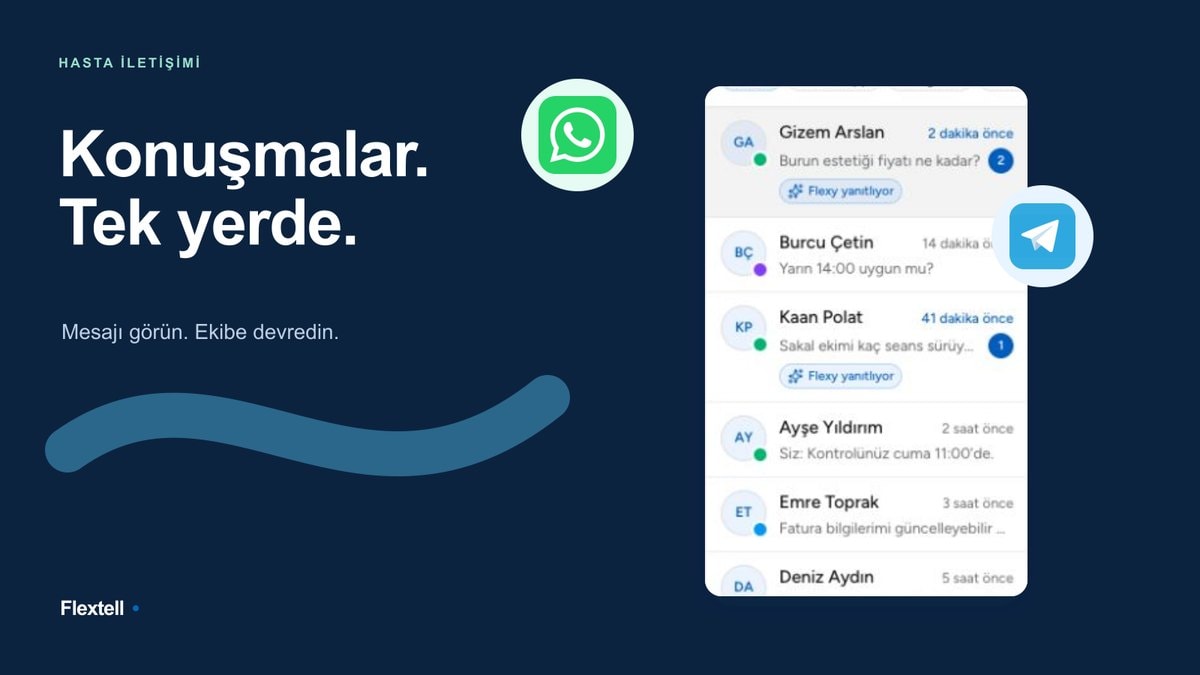
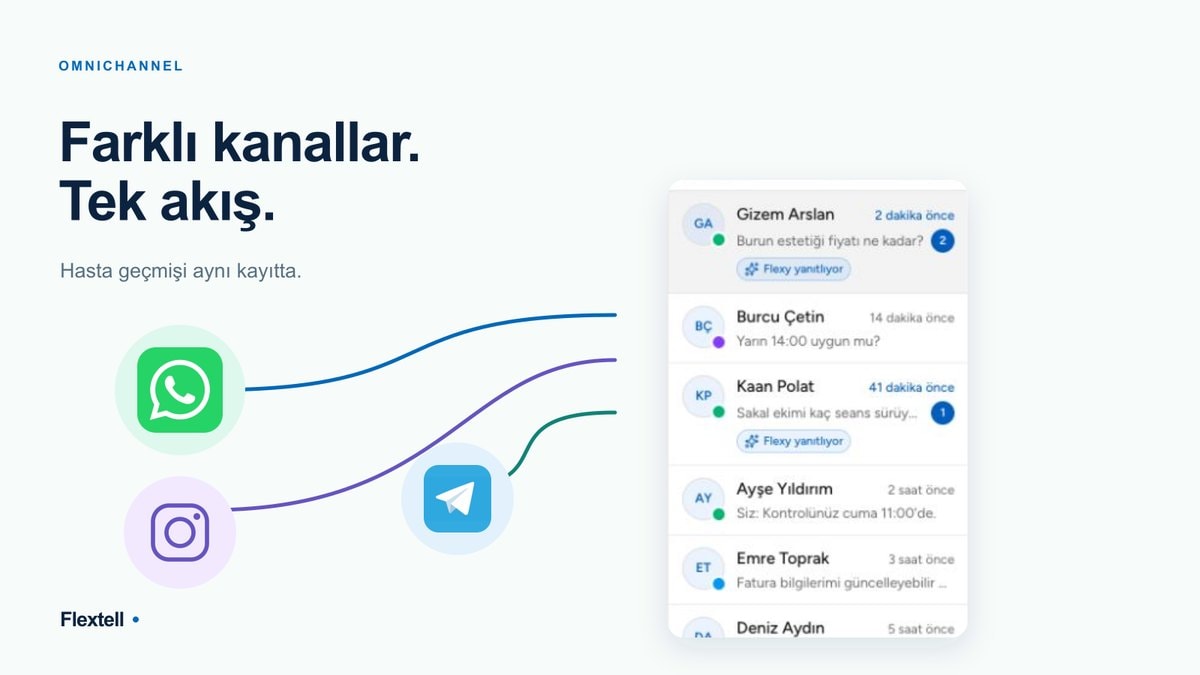
Messages from WhatsApp, Instagram DM, and Telegram are handled automatically. Conversations from all channels are managed from a single Flextell panel; staff don’t have to switch between different apps.
When clinic information is updated, does the assistant reflect it automatically?
Yes. The assistant looks at the current data in Flextell for every reply. When a doctor’s schedule changes, a new treatment is added, or working hours are updated, the assistant replies with the current data the next time the relevant information is asked about.
Does the system also work for voice calls?
For now, Flextell’s automatic reply system works on text-based communication channels: WhatsApp, Instagram DM, and Telegram. Voice call support is among future development plans.
After-hours patient loss can now be prevented
The hour the clinic closes is not the hour patient requests stop. The difference between these two hours, the gap between closing and the moment requests cease, makes up the pool of patients the clinic systematically loses.
Flextell’s 24/7 automatic patient reply system closes this gap. Every message that arrives, at any hour, is handled, every appointment request is processed, every question is answered. When staff arrive in the morning, an organized appointment list is waiting, not a backlog of messages.
If you’d like to see how the AI assistant works together with the other modules of the clinic platform, you can look at our clinic AI assistant guide here.
This content was prepared by the Flextell team. Last updated: April 2026.