
AI assistant for clinics: A detailed usage guide
Running a clinic takes a strong operational foundation alongside patient care. Appointment requests that arrive outside working hours, patient messages piling up on different platforms, and repetitive notification and reminder processes all put a heavy workload on staff, and as response times grow longer, the patient experience is directly affected. Another cost of this load is that the time you have isn’t used productively and qualified patient records are missed.
9 April 202610 min read
In this article
- What is a clinic AI assistant?
- What doesn’t change in clinic management without an AI assistant?
- What does the AI assistant do in the clinic?
- How does the AI assistant work integrated with the clinic modules?
- Does the AI assistant replace staff?
- Clinic efficiency with Flextell’s AI assistant
- Which clinics benefit most from the AI assistant?
- Patient notification messages: Templates and customization
- Frequently asked questions
- The AI assistant is the clinic’s quiet worker
Flextell’s AI assistant is designed to take on this operational load. It answers patient requests that arrive over WhatsApp, Instagram DM, and Telegram, books appointments, delivers reminder messages on time, and hands the process over to staff when human intervention is needed. All of this runs nonstop, 24/7, fully integrated with the clinic platform’s appointment, calendar, patient management, and reporting modules.
In this guide we walk step by step through exactly what Flextell’s AI assistant does in the clinic, how it steps in across the modules, and what it contributes to clinic operations.
What is a clinic AI assistant?
A clinic AI assistant is an AI-powered software component that carries out patient communication, appointment processes, and repetitive clinic operations automatically, without human intervention.
Traditional clinic software records, sorts, and reports transactions, but it doesn’t take initiative. Assistants wait, patients wait, and staff try to keep up with the messages. An AI assistant offers a fundamentally different alternative to this picture: the system no longer just keeps records, it actively takes part in the processes.
In Flextell, the AI assistant is not a standalone application. It is a layer built into the clinic platform that works directly integrated with the appointment, calendar, patient management, messaging, and reporting modules. The whole chain, from the patient’s message to the appointment landing on the calendar, from the reminder message to the no-show report, flows without a break thanks to this integration.
Would you like to explore all the modules of clinic management software? You can find our complete guide to clinic management software here.
What doesn’t change in clinic management without an AI assistant?
To understand the value of an AI assistant, you first need to picture what things look like without one.
Staff answer dozens of similar messages a day: "Can I book an appointment?", "What time are you available?", "What is the price?", "I want to cancel." Each one takes separate attention, a separate screen switch, a separate act of typing. When these low-value, high-frequency tasks pile up, a significant part of staff’s hours is used up; and they stop altogether on weekends and after hours.
On the patient side there is an experience problem too: a message sent at night goes unanswered until morning, and the opening hours the patient wondered about are learned only on the next business day. This wait shapes the patient’s perception of the clinic.
Flextell’s AI assistant solves both problems at once: it takes on staff’s repetitive communication load and gives the patient an instant reply regardless of the hour.
What does the AI assistant do in the clinic?
Flextell’s AI assistant plays an active role at several points in clinic operations. Each is covered separately below.
24/7 patient communication and automatic replies
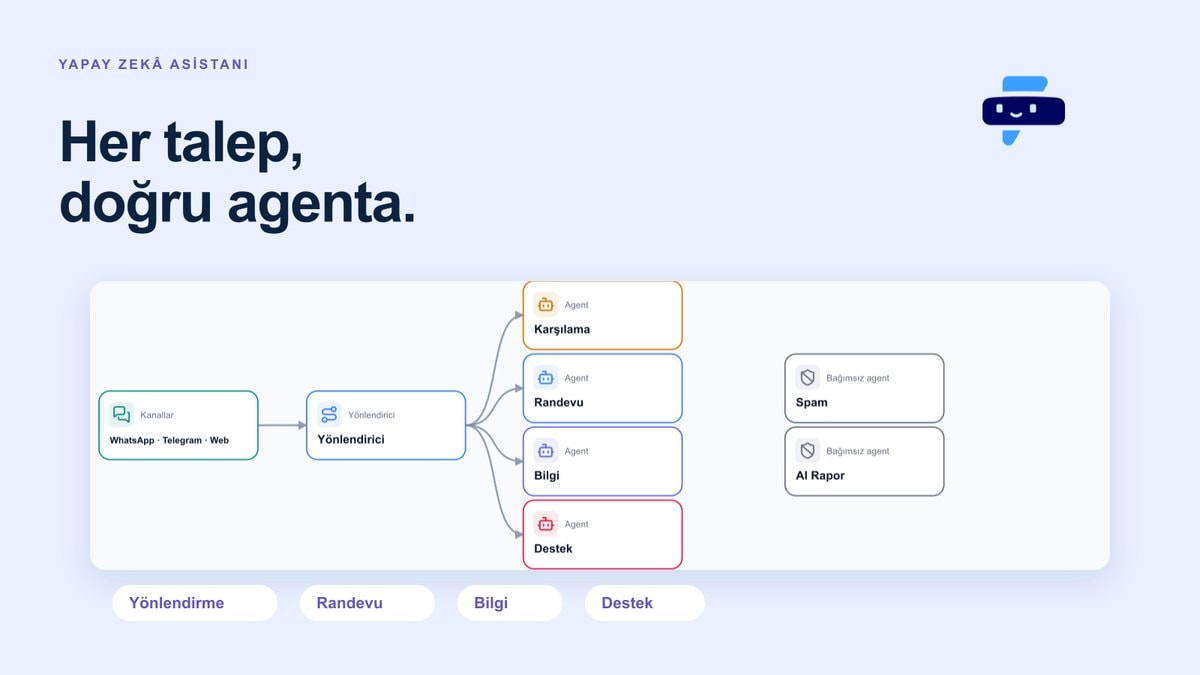
The AI assistant receives and answers patient messages from WhatsApp, Instagram DM, and Telegram in real time. It replies to the patient directly on frequently asked topics such as appointment requests, time queries, price information, the clinic address, and doctor information.
Replies draw on the information the clinic defines in Flextell: doctor profiles, treatment descriptions, working hours, clinic information. By reading this data, the assistant gives the patient accurate and consistent information.
This process works regardless of working hours. Every message that arrives, at any hour, is assessed instantly.
Curious how the 24/7 automatic patient reply system works? You can find our detailed guide here.
Automatic appointment booking
When a patient says they want to book an appointment over WhatsApp or another active communication channel, the AI assistant manages the process from start to finish: it identifies the right treatment, offers the available doctors and times, takes the patient’s choice, and saves the appointment to the Flextell calendar.
Calendar rules apply exactly as they do elsewhere in this process: no appointment is entered outside working hours or on taken slots, and overlaps are blocked by the system. The assistant applies these checks automatically; no human intervention is needed.
Would you like to look at every step of clinic appointment management? You can find our clinic appointment management guide here.
Automatic appointment reminders and no-show prevention
After an appointment is confirmed, the AI assistant sends the patient an automatic reminder message at set time intervals. The message content automatically includes the appointment date, time, and doctor information; timing and content can be customized to the clinic’s preference. If you wish, preparation steps the patient needs to know before the treatment, points to watch out for, or documents to bring can also be included in this reminder message.
If the patient replies to the reminder message with a cancellation or change request, the assistant handles it. The freed-up slot automatically becomes available on the calendar again. This cycle runs without staff having to follow messages one by one, and it lowers the no-show rate meaningfully.
Curious about the effect of the appointment reminder system on the no-show rate? You can find our detailed guide here.
Omnichannel patient communication: All channels in one panel
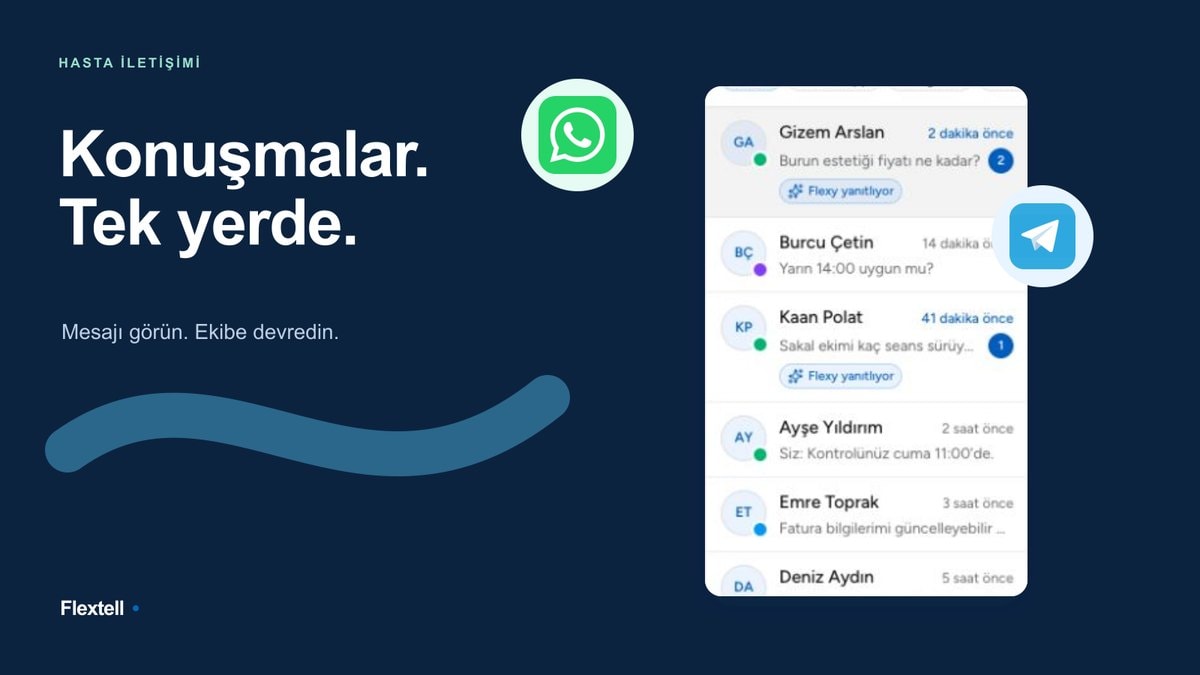
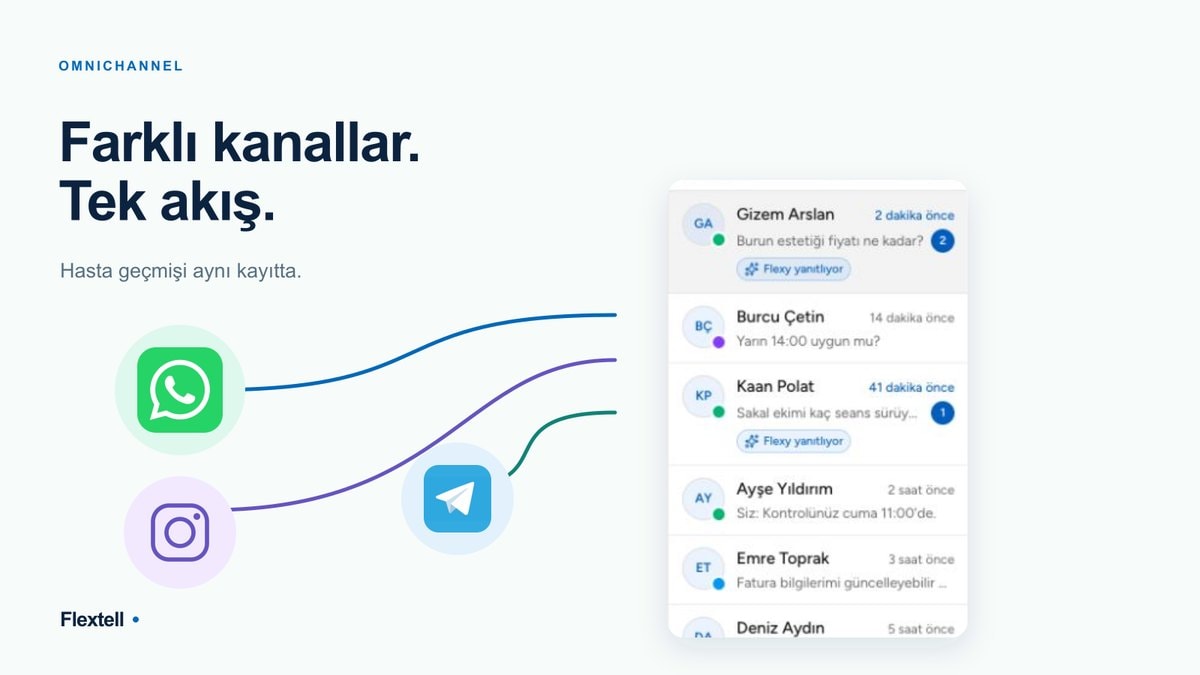
Patients use different platforms to reach the clinic: one patient writes on WhatsApp, another on Instagram DM, and another on Telegram. Flextell’s AI assistant works on all three channels at the same time; all incoming messages are displayed and managed in a single panel.
This integration has two important results. First, whichever channel a message comes from, none is missed. Second, because the assistant can communicate with several patients at the same time, response time doesn’t grow longer even in busy periods.
Would you like to look at what omnichannel patient communication contributes to the clinic? You can find our detailed guide here.
Filtering spam and malicious messages
At high-traffic clinics, channels can fill up from time to time with unwanted messages: ad content, meaningless queries, or repeating bots. Flextell’s AI assistant detects and filters these kinds of messages, letting clinic staff keep their attention on real patient requests.
Curious how spam and malicious user management works? You can find our detailed guide here.
AI-powered reporting and analytics
Flextell’s AI layer takes part not only in patient communication but also in clinic performance analysis. Metrics such as appointment occupancy rate, no-show distribution, revenue by treatment, and staff productivity are compiled automatically from 10 different system sources and interpreted by the AI.
Traditional reporting tools list the data; Flextell’s AI-powered reporting module makes sense of it and gives the clinic manager takeaways. On request, reports can be generated automatically on a daily, weekly, or monthly basis; reports can be exported as PDF.
Curious how AI reports contribute to decision-making? You can find our detailed guide here.
Creating support requests
The AI assistant automatically detects messages in patient conversations that could become a support request. When a message arrives containing a complaint, a side-effect report, a request for information, or a suggestion, the assistant classifies it and saves it to the support request system. This way no feedback goes unrecorded.
Handover to human staff
When a conversation is emotionally charged, contains a complaint, or is something the AI assistant can’t answer, the system automatically creates a support request on the matter and sends the relevant staff member a notification. This way, staff can give the patient the support they need as the process moves forward.
This balance holds the efficiency of AI and the need for the human touch together.
Curious how AI and human staff are brought into harmony? You can find our detailed guide here.
How does the AI assistant work integrated with the clinic modules?
The power of Flextell’s AI assistant doesn’t come from messaging alone. Because the assistant works directly integrated with the clinic platform’s other modules, it takes its input from real clinic data, and its outputs directly affect clinic processes.
Doctor profiles: The assistant reads each doctor’s biography and specialty information to route patients correctly. The question "Which doctor would you recommend for an aesthetic procedure?" is answered from the doctor information defined in the system.
Treatment definitions: The treatments the clinic offers, their durations, prices, and VAT rates are defined in the system. The assistant answers patient questions by accessing this information; the risk of giving inconsistent information on price or duration goes away.
Calendar and availability: When booking an appointment, the assistant checks the doctor’s current calendar status in real time. It doesn’t offer a slot that is already full; it shows only the options that are truly available.
Patient cards: Patient information obtained during the conversation (name, phone, preferences) is automatically entered on the patient card. Staff don’t need to enter the information separately.
Does the AI assistant replace staff?
This is one of the most frequently asked questions about the AI assistant, and the answer is nuanced.
Flextell’s AI assistant can reach a patient base larger than existing staff could handle, and in that way may mean the need to hire new staff never arises. But a little human support is still needed for the assistant to be put in place and for the processes to be managed.
The goal isn’t to sideline staff but to free their energy from repetitive, low-value work and direct it to the moments that truly need a human touch.
Would you like to look more closely at assistant training and human-AI harmony? You can find our detailed guide here.
Clinic efficiency with Flextell’s AI assistant
The AI assistant’s contribution to clinic operations isn’t limited to communication speed. When set up properly, the assistant affects occupancy rate, patient satisfaction, and staff workload together.
The average response time to patient messages drops to the level of seconds. The no-show rate falls meaningfully thanks to automatic reminders. Freed from routine message traffic, staff focus on the patient experience and coordination inside the clinic.
Would you like to see how all these gains work together? You can find our guide on clinic efficiency with AI here.
Which clinics benefit most from the AI assistant?
Flextell’s AI assistant creates value for clinics of every size, but some profiles get a larger share of it.
Clinics with a single doctor and an assistant: At small clinics, the AI assistant is the most practical way to add capacity without extra staff.
Laser hair removal and skin care centers: Managing recurring session appointments and reminder processes are among the scenarios where the AI assistant works most efficiently.
Multi-doctor polyclinics: In setups with several doctors, sorting the flow of questions for each doctor and routing correctly is one of the critical roles the assistant takes on.
Aesthetic and beauty clinics: At these clinics, which see heavy appointment traffic over Instagram DM and WhatsApp, the assistant manages channel-based queries automatically and raises the daily appointment occupancy rate.
Curious about using an AI assistant built for aesthetic clinics? You can find our detailed guide here.
Patient notification messages: Templates and customization
In Flextell, appointment reminders, confirmation messages, and cancellation notices are based on templates the clinic can customize. Details such as the date, time, doctor name, and clinic name are filled in automatically; the message content can be edited to suit the clinic’s wishes and communication style.
Would you like to learn how to build effective patient notification message templates? You can find our detailed guide here.
Frequently asked questions
Which communication channels does Flextell’s AI assistant work on?
It can process messages from WhatsApp, Instagram DM, and Telegram. Appointment requests and patient questions from all of these channels are managed from a single Flextell panel.
What happens if Flextell’s AI assistant gives wrong information?
The assistant generates replies based on the clinic data defined in Flextell (doctor profiles, treatment information, working hours). If wrong or incomplete information has been entered into the system, the assistant replies with that information. That’s why keeping clinic information up to date is important. When it can’t answer or can’t be sure, the AI assistant, if it deems it necessary, automatically creates a support request on the matter; this request can be answered by the relevant assistants. Technically, Flextell creates the request and continues the chat.
Do I need technical knowledge to use Flextell’s AI assistant?
No. Setting up the assistant in Flextell consists of steps that don’t require any technical infrastructure. Once the clinic information, doctor profiles, and treatment definitions are entered in the system, the assistant starts working.
How many patients can Flextell’s AI assistant communicate with at the same time?
There is no technical limit on simultaneous communication. In busy periods, the assistant can hold conversations with several patients at once; response time isn’t affected by the number of patients.
Can the conversation with the patient continue after an appointment is booked?
Yes. After an appointment is booked, the patient can reply to reminder messages and make cancellation or change requests. These requests are also handled by the assistant.
What happens to messages the AI assistant can’t understand?
When the assistant isn’t enough, the system automatically creates a support request on the matter. This request can be answered by the relevant assistants.
Can I try the AI assistant before buying Flextell?
Yes. You can try Flextell for free and test the assistant in your own clinic setup. You can also request a demo to arrange a one-on-one introductory meeting with a team member.
The AI assistant is the clinic’s quiet worker
The system that handles an appointment request at midnight, sends the reminder message on time, prepares reports automatically, and directs staff’s attention to the moments that truly matter has a simple name: the AI assistant.
In Flextell, this assistant works integrated with every module of the clinic platform. It takes an active part in every link of the chain from appointments to reporting, from messaging to the patient card.
If you’d like to see the entire clinic operation on a single platform, you can look at our complete guide to clinic management software here.